
Purchase any WEBINAR and get
10% Off
CODE: SAVE10
T&C applicable, please referFAQ
Validity : 16th Jul'26 to 26th Jul'26
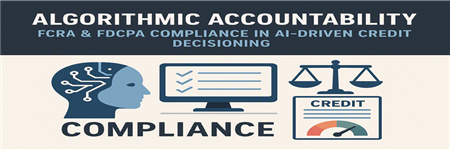
As financial institutions, credit reporting agencies, and debt collectors increasingly rely on artificial intelligence to drive credit decisions and consumer communications, the gap between innovation and compliance has narrowed sharply. This program examines how the Fair Credit Reporting Act (FCRA) and Fair Debt Collection Practices Act (FDCPA) apply directly to automated and AI-driven systems, with no carve-out for algorithmic decision-making.
Beginning with the current regulatory landscape — including CFPB guidance, joint interagency enforcement priorities, and recent consent orders — the session walks through how accuracy obligations, dispute and reinvestigation duties, and furnisher responsibilities apply when data is generated or processed by AI. It then turns to the FDCPA, addressing disclosure risks, misrepresentation at scale, and timing/frequency violations that arise from automated communications and algorithmic scheduling. Using case-based scenarios, the program illustrates how a single systemic error introduced at the data input stage can propagate across thousands of consumer files and how liability attaches across furnishers, credit reporting agencies, and service providers. The session concludes with practical risk mitigation strategies, including internal controls, human review checkpoints, and audit-trail documentation standards that regulators and courts now expect as part of a defensible compliance program. Attorneys, compliance officers, and collection operations leaders will leave able to identify their organization's highest-risk automated processes and implement controls that withstand regulatory and litigation scrutiny.
Lenders, credit bureaus, and debt collectors are rapidly adopting AI and automated decisioning systems — but regulators have made clear there is no AI exemption to existing law. The CFPB, FTC, and federal banking regulators have jointly confirmed that automated outputs carry the same FCRA and FDCPA obligations as human-driven decisions, and enforcement actions are already targeting furnishers and collectors with weak AI oversight. This session equips attorneys, compliance officers, and risk managers to identify where automated credit reporting and collections workflows create liability exposure, understand how accuracy, reinvestigation, and validation-notice obligations apply to algorithmic systems, and build defensible, audit ready compliance frameworks before regulators or plaintiffs' counsel come knocking. Attendees will leave with a practical roadmap for integrating human review checkpoints and documentation standards into AI-driven decisioning without sacrificing operational efficiency.

Tim Sanders is the Founder & CEO of Credit Repair of Florida, based in Winter Springs, FL. He is a continuing legal education (CLE) speaker and compliance trainer specializing in consumer credit reporting, the Fair Credit Reporting Act (FCRA) and Fair Debt Collection Practices Act (FDCPA), Metro 2/e-OSCAR reporting systems, CFPB regulatory developments, and the emerging liability risks of AI and automation in credit decisioning and debt collection. Tim regularly delivers accredited training programs through Lorman Education Services and ComplianceIQ, helping legal and compliance professionals navigate the intersection of consumer protection law and financial technology.


